
Ability test · 2D and 3D visualisation
See who can picture shapes turned, folded and combined in their mind's eye
Candidates compare, rotate, combine and reflect shapes in two and three dimensions, including folding cubes and mirror images. An Assessor Report shows percentile, score band, speed and accuracy; a Candidate Report gives supportive development advice without scores. Often searched for as a spatial awareness test or spatial ability test, it measures the visual-spatial reasoning behind mental rotation. What is spatial reasoning? It is the ability to picture and manipulate shapes in the mind, so this visual reasoning test also measures what people call spatial intelligence, spatial relations, spatial recognition and spatial aptitude. Multiple language versions are available.
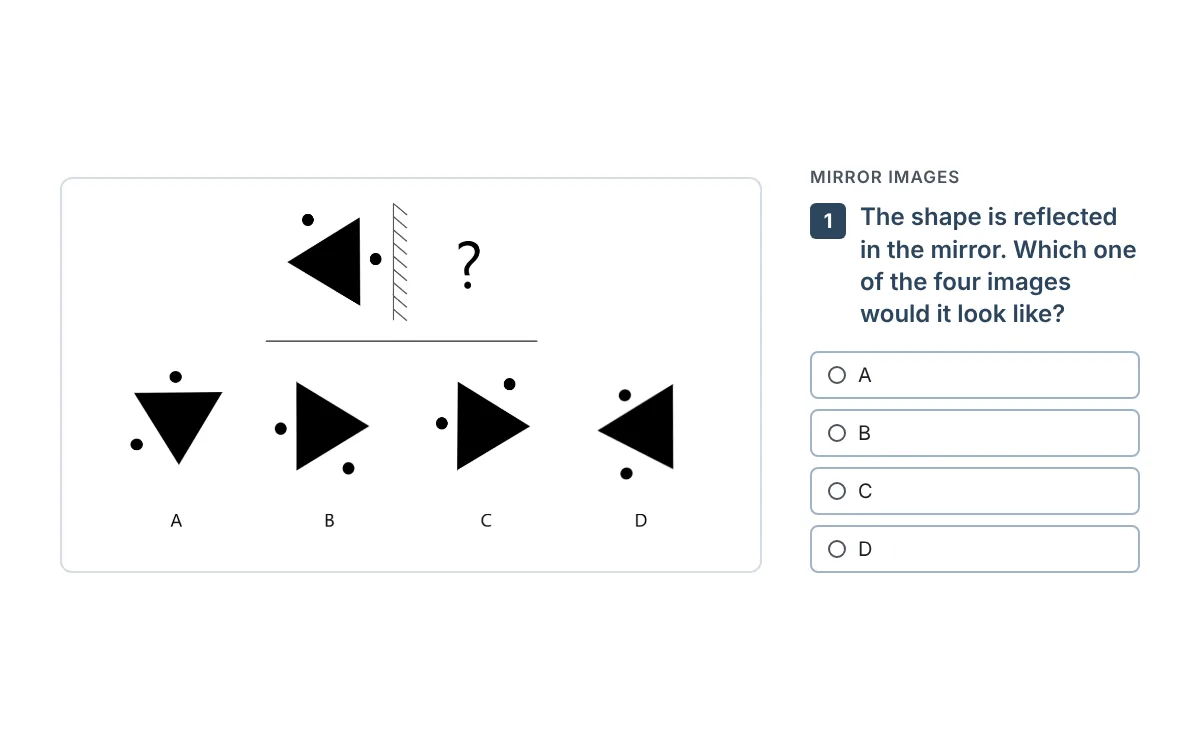
See what candidates see
Visualise how shapes look when they are moved, turned or combined. 40 items in 20 minutes.
Try example questions in the same format candidates see. It is free and takes a few minutes.
What the Spatial Reasoning Test measures
The Spatial Reasoning Test measures the ability to think about objects in 2 and 3 dimensions and draw conclusions about them from limited information. Questions involve comparing, rotating, assembling and reflecting shapes.
Mental rotation
Recognising the same shape when it has been turned.
Spatial visualisation
Picturing how parts combine and how a net folds into a cube.
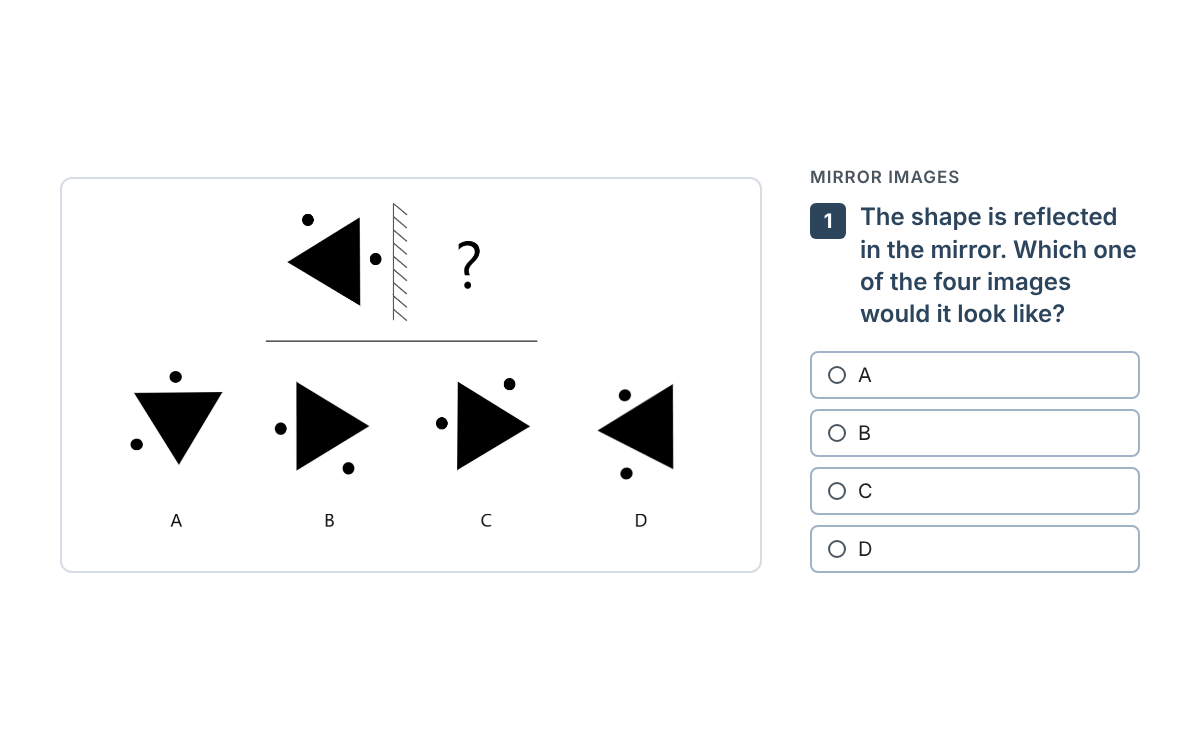
Reflection
Working out what a shape looks like in a mirror.
Why organisations choose Viewpoint ability tests
Fair and objective
Every candidate takes the same test, scored the same way, so decisions rest on evidence rather than impressions.
Candidates know what to expect
Clear instructions and example questions come before the test starts, so nobody is caught out by the format.
Reports you can act on
Clear results and score bands from Very Low to Very High, ready for shortlisting or a feedback conversation.
Fits your process
Use it to screen applicants early, to shortlist, or to add objective evidence at the final stage.
Reports that do the work for you
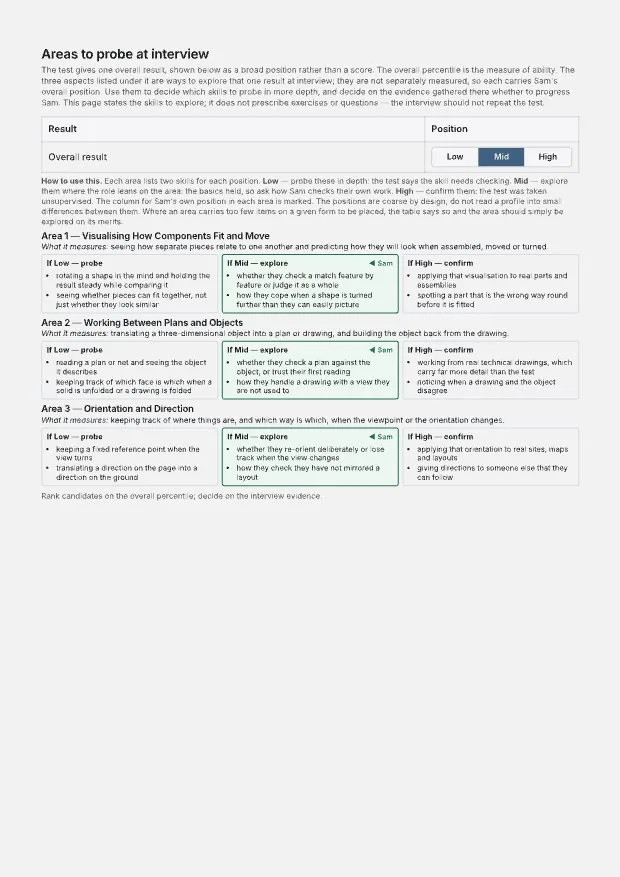
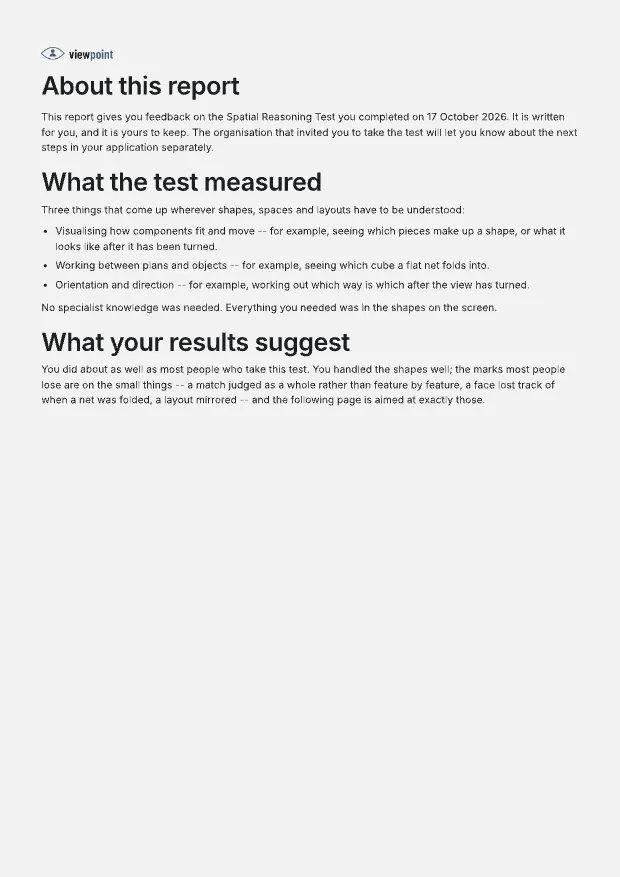
Two reports are available: an Assessor Report showing the candidate's percentile and score band (Very Low to Very High) against the norm group, with speed and accuracy, and a Candidate Report with no scores, giving supportive development advice.
View sample
Assessor Report
For recruiters and hiring managers
- Score band from Very Low to Very High
- Speed and accuracy
- Interview questions to explore the result
View sample
Candidate Report
For the person who took it
- Constructive feedback in plain English
- No scores shown
- Practical suggestions for development
Who it’s for
Typical roles that use the test.
Technical roles
Assess the spatial visualisation engineers, graphic designers and plumbers use every day.
Construction and design
Find builders, architects and cartographers who reason confidently about objects in 3D.
Transport roles
Measure mental rotation and spatial judgement for drivers, pilots and surveyors.
How it works
- 1
Invite
Send candidates their link from the Viewpoint platform. They can take the test wherever suits them.
- 2
Practise, then take the test
Candidates read the instructions and try example questions before the test starts.
- 3
Get the results
Results are ready as soon as the candidate finishes. Download the report and use it straight away.
At a glance
- 40 items, completed in 20 minutes
- 4 question sets of 10, each on a different spatial concept
- Multiple choice
- Question types: odd shape out, combining shapes, folding cubes and mirror images
Related tests
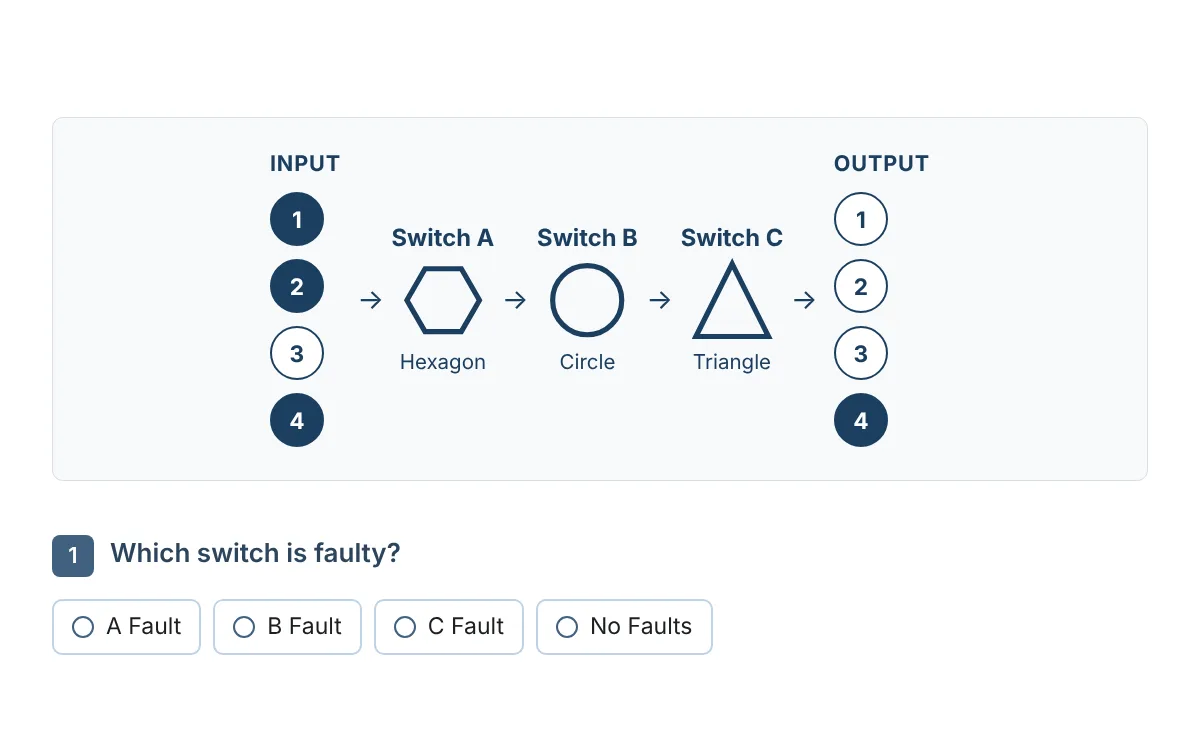 Fault Finding TestWork out which switch in a sequence is faulty from its input and output. 25 questions in 20 minutes.
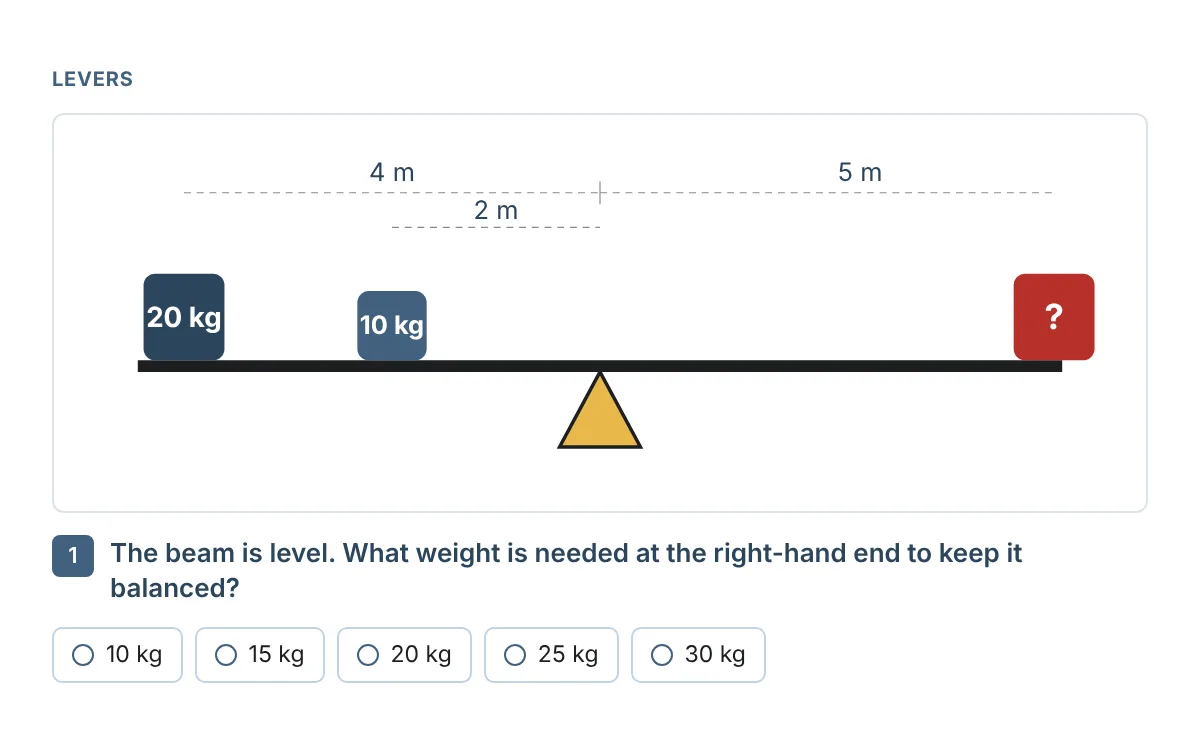 Mechanical Comprehension TestApply mechanical principles to diagrams of everyday mechanisms. 32 items in 20 minutes.
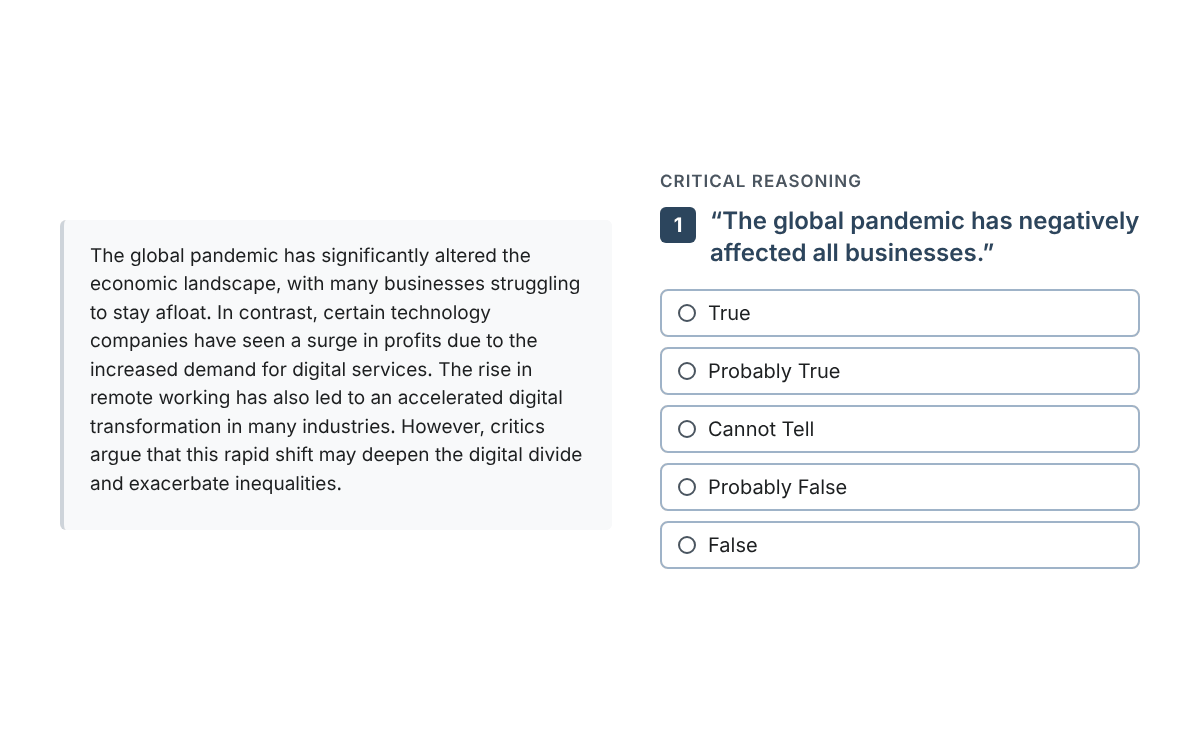 Critical Reasoning TestEvaluate inferences, assumptions, deductions, interpretations and arguments in business contexts.
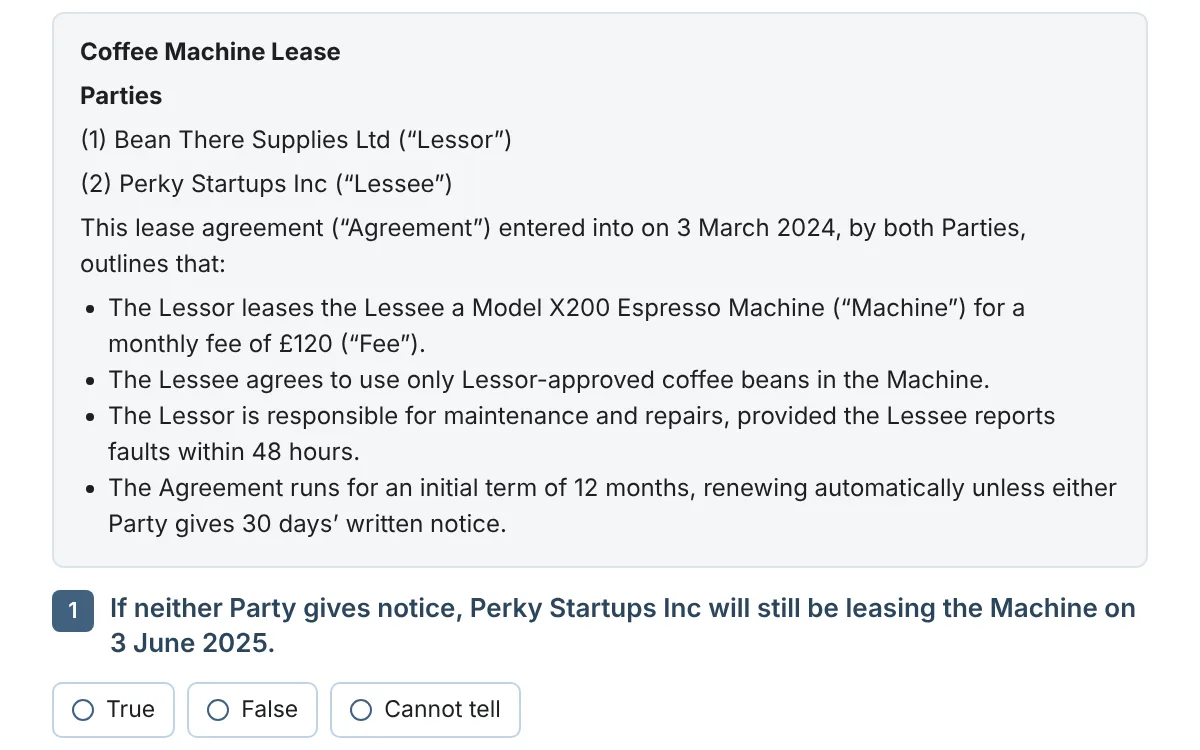 Legal Comprehension TestCheck legal passages for accuracy, terminology and formatting. 47 items in 25 minutes.
How candidates can do their best
Study the shapes carefully
Note each shape's features, then picture the change the question asks for.
Learn the rule
There are only four kinds of question, so once you know the rule you can apply it quickly.
Make your best choice and move on
The test is timed. If you are not sure, make your best choice and move on to the next question.
Learn more about spatial reasoning
What spatial reasoning looks like at work, the question styles explained, and how to prepare.
Spatial Reasoning Test: frequently asked questions
What does a spatial reasoning test measure?
The ability to think about objects in two and three dimensions and draw conclusions about them from limited information. Questions involve comparing, rotating, combining and reflecting shapes.
How long is the Spatial Reasoning Test?
40 multiple-choice questions in 20 minutes, in four sets of 10: odd shape out, combining shapes, folding cubes and mirror images.
Can candidates practise before the test?
Yes. Candidates read the instructions and do practice questions before the test starts. Anyone can also try the free example questions on this page.
Is there a pass mark?
No. The Assessor Report shows the candidate’s percentile and score band, from Very Low to Very High, against the norm group, with speed and accuracy. You decide how to use the result alongside your other evidence.
Do candidates see their score?
No. The Candidate Report gives supportive development advice and shows no scores.
Which roles is it used for?
Technical roles such as engineers, graphic designers and plumbers; construction and design roles such as builders, architects and cartographers; and transport roles such as drivers, pilots and surveyors.
See the Spatial Reasoning Test for yourself
Try it and see the reports your team would receive. Contact us for a free trial or a demonstration of the platform.
More Free Tests
Try additional psychometric tests for free:
Take a Free SJT Take a Free Personality Test Take a Free Critical Reasoning Test Take a Free Barista SJT