
Type indicator · Registered with the BPS
Help people and teams understand each other, and work better together
The Type Dimensions Profiler (TDP) is based on Carl Jung's Psychological Types. In about 7 minutes it identifies one of 16 personality types, described in positive, constructive language that makes it ideal for teams, leaders and coaching.
Registered with the British Psychological Society
Why organisations choose the TDP
Registered with the BPS
Registered with the British Psychological Society, the mark of a reliable, valid and fair test.
Positive and constructive
Written in positive, constructive language that people engage with and remember.
A report for every conversation
Leadership, coaching, communication, change, inclusion and emotional intelligence, all from one completion.
Available in multiple languages
Use the same questionnaire and reports across international teams.
What the TDP measures
The TDP identifies a person's preferences on 4 dichotomies from Jung's Psychological Types. Together they give one of 16 personality types.
Where you focus your energy
The outer world of people and activity, or the inner world of ideas.
How you take in information
Concrete facts and experience, or patterns and possibilities.
How you make decisions
Objective logic, or values and the impact on people.
How you approach life and work
Planned and organised, or flexible and spontaneous.
Reports for every development conversation
Nine reports from a single completion of the profiler. Start with the Introductory or Profile Report, then go deeper on leadership, coaching, communication, change, inclusion or emotional intelligence.
View sample
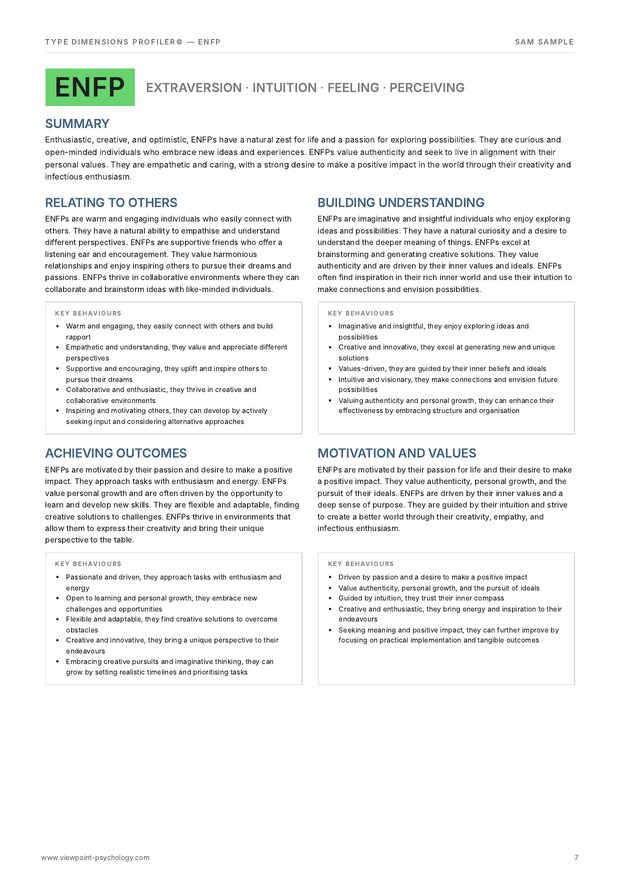
Introductory Report
Anyone new to Type; individuals and teams
- The four dimensions and the sixteen TDP Types explained
- Summary Profile with preference clarity for each dimension
- A full ENFP type description and an introduction to type dynamics
View sample
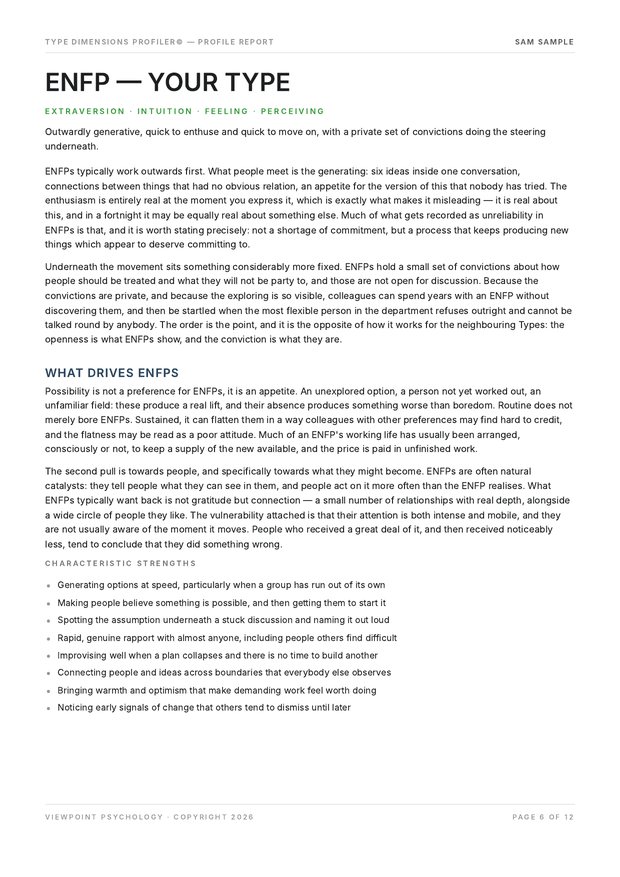
Profile Report
Individuals wanting their full Type profile
- Your four dimensions with preference clarity, and your type dynamics
- Your Type at work, with other people and under pressure
- Development suggestions and guidance on verifying your best-fit Type
 View sample
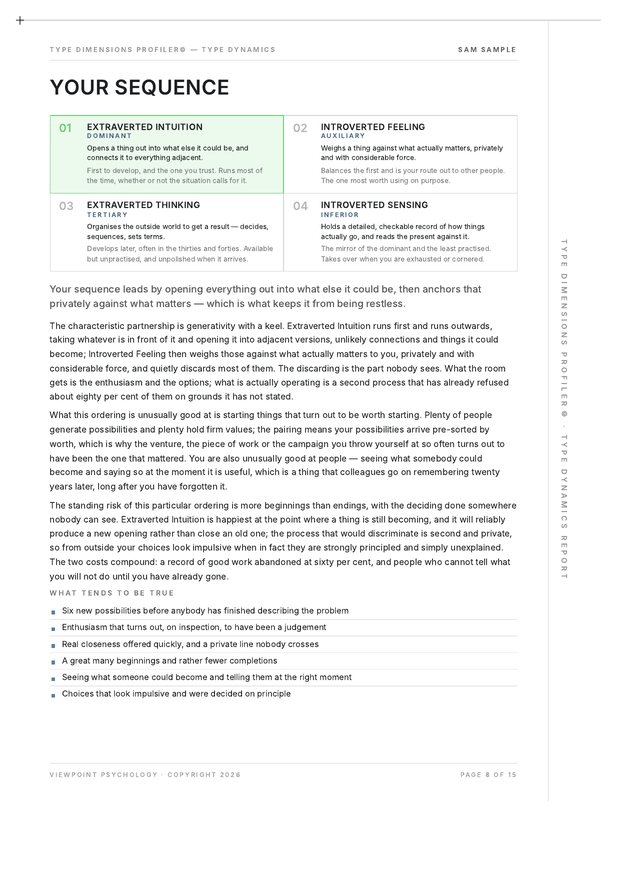
Type Dynamics Report
Individuals and coaches going beyond the four letters
- The eight mental processes and how your four letters give your sequence
- Your dominant, auxiliary, tertiary and inferior processes, one page each
- When the fourth process takes over, the sequence across a life, and development
View sample
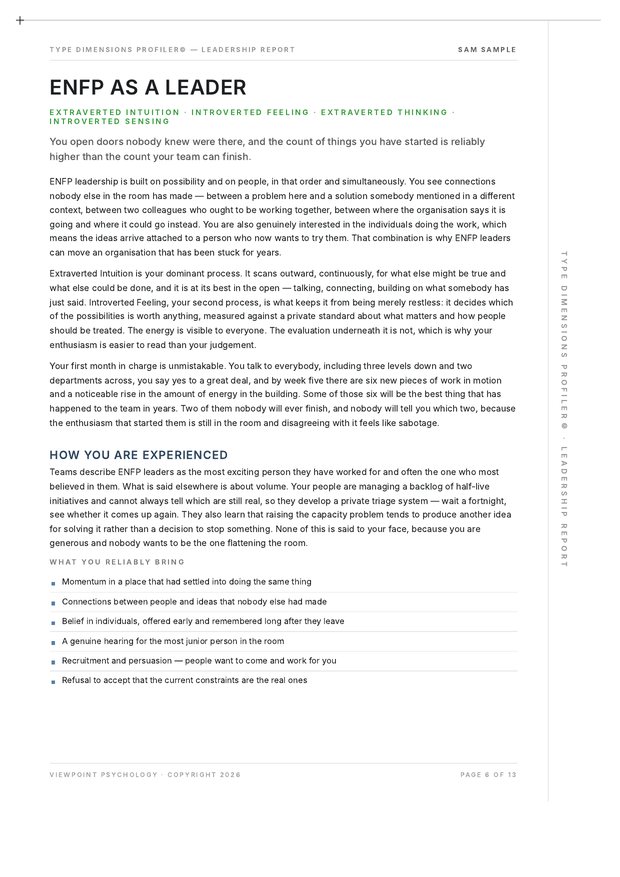
Leadership Report
Leaders and leadership coaches
- The four dimensions and type dynamics as they apply to leadership
- Your Type as a leader: decision-making, communication, change and developing people
- Leading people unlike you, leading under pressure, and development
 View sample
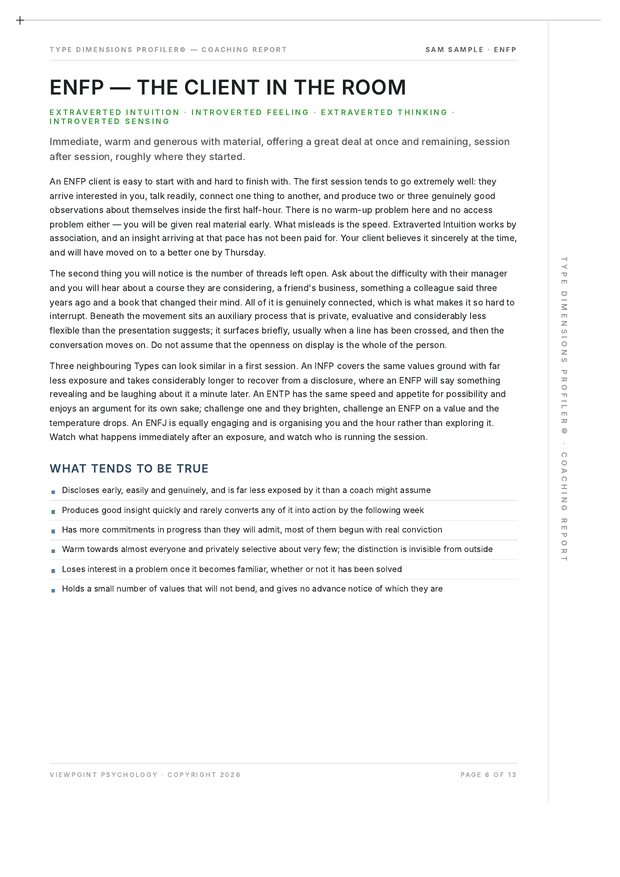
Coaching Report
Coaches (a practitioner document about the client)
- The client's preference clarity and where the coaching work sits in their type dynamics
- What the client needs from you, how they may avoid the work and the goal underneath
- Coaching through a stress reaction, the development edge, session craft and boundaries
 View sample
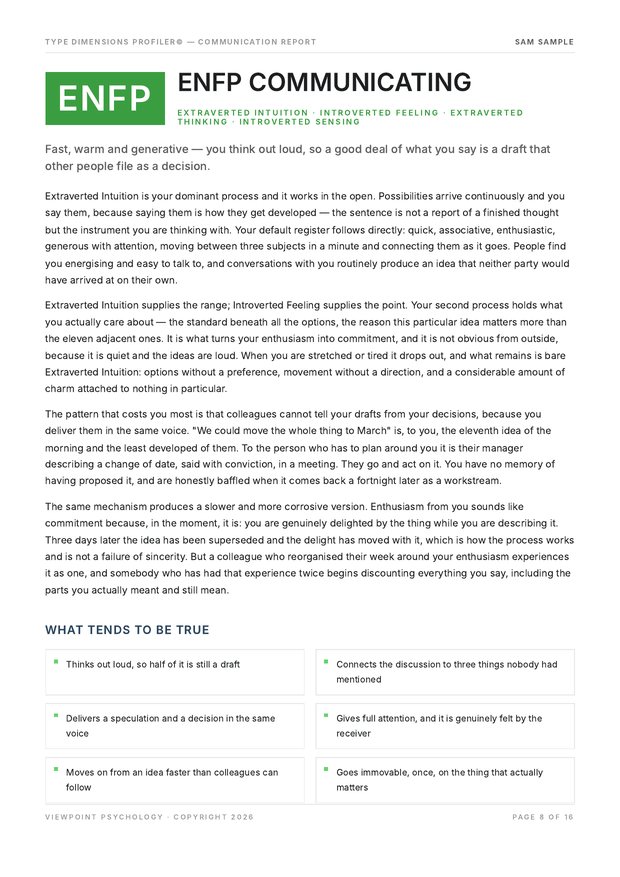
Communication Report
Individuals and teams improving communication
- How the sixteen Types communicate, the Type wheel and the four function pairs
- How you take information in, how you put it out, in meetings and in writing
- How you are misread, communicating with people unlike you, under pressure, and development
 View sample
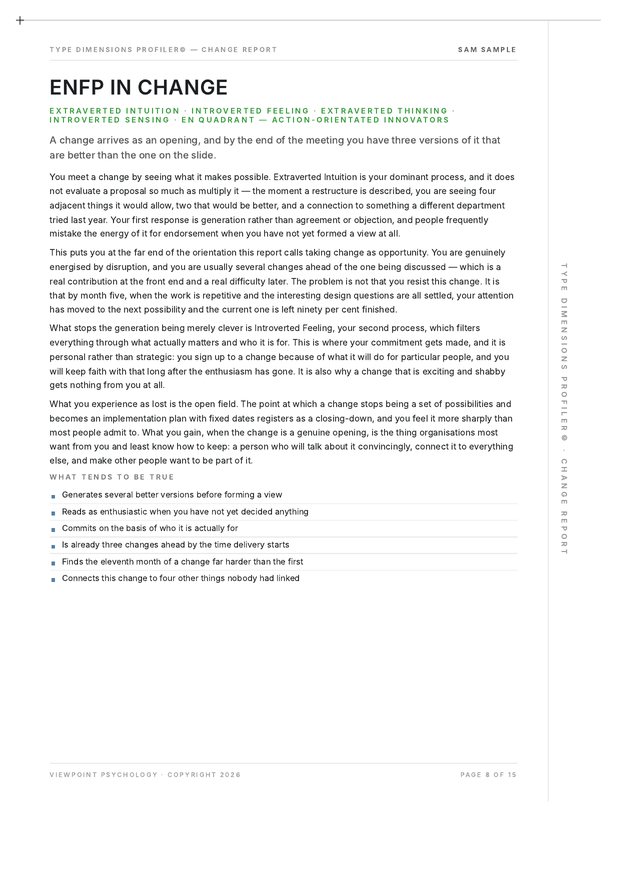
Change Report
Individuals, change leaders and coaches
- The four dimensions in change and the four change quadrants
- What you need before you can move, what you resist and what you contribute
- Running a change, through the transition, under sustained change, and development
 View sample
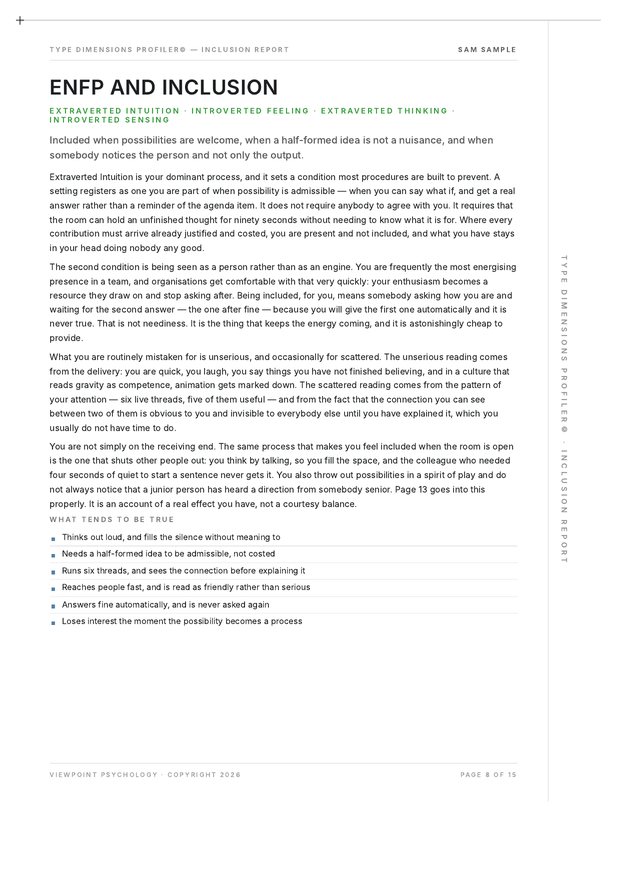
Inclusion Report
Individuals, managers and inclusion leads
- The four dimensions and inclusion, the four things people need, and masking
- What makes you feel heard, what isolates you and what respect means to you
- Including people unlike you, when exclusion goes on too long, and development
 View sample
Emotional Intelligence Report
Individuals and coaches working on emotional intelligence
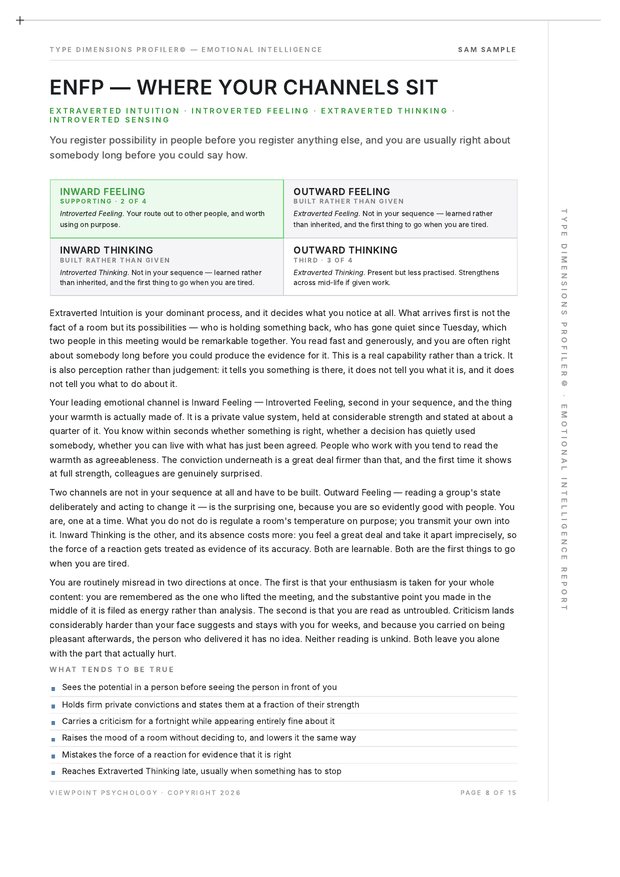
- The four emotional channels and why emotional intelligence can collapse under pressure
- Self-awareness, managing your own reactions and reading other people
- Handling others' feelings, difficult conversations and repair, and development
Where the TDP makes a difference
Team development
Give teams a shared language for their differences and how to work with them.
Leadership development
Help leaders see their natural style, their talents and their blind spots.
Coaching
A positive, memorable starting point for coaching conversations.
Self-understanding
Help individuals understand their own type and how they come across.
How it works
- 1
Invite
Send participants their link from the Viewpoint platform.
- 2
Complete
Each of the 60 items is the start of a statement with 2 endings; they choose the one most like them. Untimed, about 7 minutes.
- 3
Report
Download any of the 9 reports for the session, from the Introductory Report to Leadership, Coaching or Change.
Which personality questionnaire is right for you?
| Talent Dimensions | Development Dimensions | Type Dimensions ProfilerThis page | Emotional Intelligence Survey | Wellbeing Dimensions Survey | |
|---|---|---|---|---|---|
| Best for | Recruitment, development and coaching | Deeper insight into behaviours that can help or hinder | Team, leadership and coaching development | Recruitment, development and coaching where emotional style matters | Coaching, self-development and wellbeing |
| Model | Big Five: 10 traits in 5 TRACE themes | 8 traits in 4 CARE themes, each with 3 sub-scales | Jung's Psychological Types: 4 dichotomies, 16 types | 6 emotional style scales, each with 2 subscales | Big Five based: 5 factors, each with 2 subscales |
| Items | 105 statements | 150 statements | 60 paired statements | 72 statements | 75 statements |
| Typical time | About 7 minutes, untimed | About 10 minutes, untimed | About 7 minutes, untimed | About 10 minutes, untimed | About 7 minutes, untimed |
| Reports | 7: Profile, Candidate, Development, Competency, Career Guidance, Leadership Style, Culture & Environment | 7: Profile, Candidate, Competency, Development, Leadership Risk, Pressure & Derailment, Team Risk & Dynamics | 9: Introductory, Profile, Type Dynamics, Leadership, Coaching, Communication, Change, Inclusion, Emotional Intelligence | Recruitment, Development, Competency, Candidate | Development report with coaching questions |
Completing the questionnaire
Answer honestly
Go with your natural preferences, not how you think you should respond.
Don't overthink
Your first instinct is often the most accurate reflection of you.
Set aside enough time
Complete it somewhere quiet, without interruptions or other people's influence.
Think across your whole life
Consider how you behave at work, at home and in social situations.
See the TDP for yourself
Try the profiler and see the reports your people would receive. Contact us for a free trial or a demonstration of the platform.
More Free Tests
Try additional psychometric tests for free:
Take a Free SJT Take a Free Personality Test Take a Free Critical Reasoning Test Take a Free Barista SJT