
Questionnaire · Emotional intelligence
See how people handle emotions: their own, and everyone else's
The Emotional Intelligence Survey (EIS) measures how people notice, understand, express and manage emotions. Six emotional style scales, each with two subscales, give a rich picture for recruitment, development and coaching, in about 10 minutes.
Take the Emotional Intelligence Survey free and see your own report →
Delivered on iTestHub, Viewpoint’s sister testing platform. Contact us and we’ll set it up for you.
Why organisations choose the EIS
Strengths at both ends
Each scale describes an emotional style, not a right answer, so every profile is presented constructively.
Interview-ready
Recruitment reports include interpretation, typical feedback comments and questions to explore each result.
Made for development
Development and coaching content helps people use their emotional style well at work.
Normed and banded
Scores are compared with a norm group and placed in five clear bands, from Very Low to Very High.
What the EIS measures
Six emotional style scales cover how people attend to, distinguish, express and manage emotion, both their own and other people's. Each scale has two subscales for more detail.
Emotional Attention
How much attention someone pays to their own feelings during the day.
Emotion Differentiation
How precisely someone can tell one feeling from another and put it into words.
Expressive Display
How visibly someone shows what they feel.
Reappraisal
How readily someone changes the way they see a situation to change how they feel.
Social Sensitivity
How readily someone picks up on other people's feelings and the mood around them.
Interpersonal Regulation
How actively someone steps in to influence how others feel.
Reports that do the work for you
Choose the report that fits the job in hand: recruitment, development, competency or candidate feedback, all from a single completion.
View sample
Profile Report
For recruiters, coaches and HR
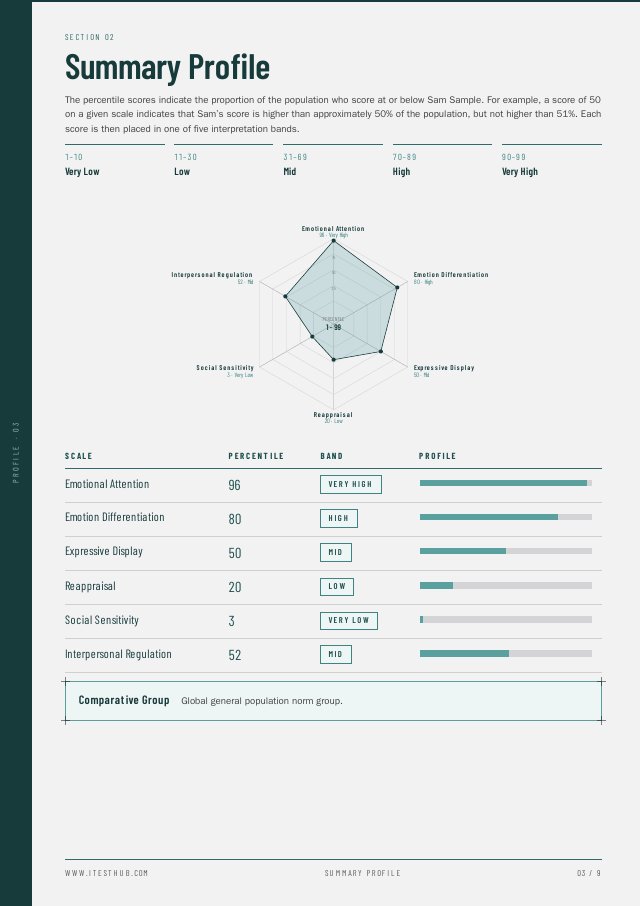
- Percentile scores for all 6 scales and 12 subscales
- Five interpretation bands, Very Low to Very High
- A clear summary profile chart
View sample
Scale detail
Inside the report
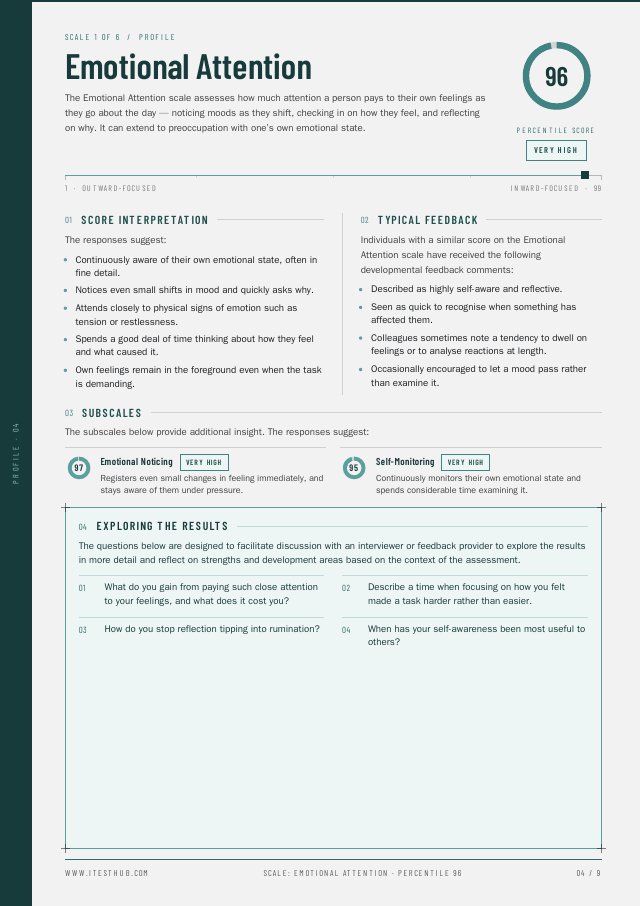
- A page for every scale
- Score interpretation and typical feedback comments
- Questions to explore each result
View sample
Profile chart
Inside the report
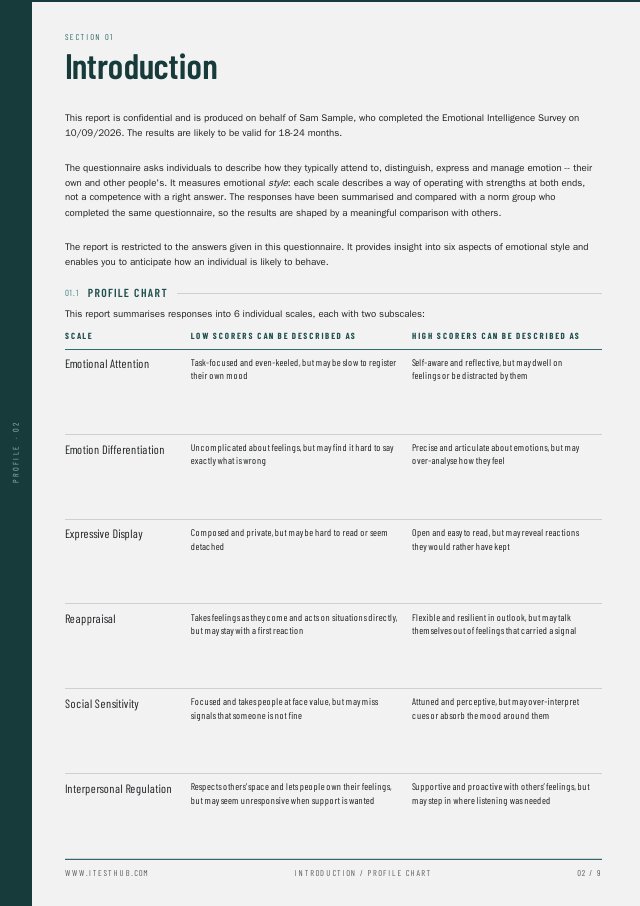
- What low and high scorers are like on each scale
- Strengths at both ends of every scale
- Written in plain, constructive language
Where the EIS makes a difference
Recruitment and selection
Add evidence on emotional style to roles where working with people really matters.
Development and coaching
Help people understand how they handle emotions and where to grow.
Leading and supporting others
Explore how someone reads and responds to the people around them.
How it works
- 1
Invite
Send candidates or employees their link.
- 2
Complete
They rate 72 short statements from Strongly Disagree to Strongly Agree, over three pages. It is untimed and takes about 10 minutes.
- 3
Report
Download the report and use it straight away.
Which personality questionnaire is right for you?
| Talent Dimensions | Development Dimensions | Type Dimensions Profiler | Emotional Intelligence SurveyThis page | Wellbeing Dimensions Survey | |
|---|---|---|---|---|---|
| Best for | Recruitment, development and coaching | Deeper insight into behaviours that can help or hinder | Team, leadership and coaching development | Recruitment, development and coaching where emotional style matters | Coaching, self-development and wellbeing |
| Model | Big Five: 10 traits in 5 TRACE pairs | 8 traits in 4 CSII pairs, each with 3 sub-scales | Jung's Psychological Types: 4 dichotomies, 16 types | 6 emotional style scales, each with 2 subscales | Big Five based: 5 factors, each with 2 subscales |
| Items | 105 statements | 150 statements | 60 paired statements | 72 statements | 75 statements |
| Typical time | About 7 minutes, untimed | About 10 minutes, untimed | About 7 minutes, untimed | About 10 minutes, untimed | About 7 minutes, untimed |
| Reports | Recruitment, Development, Candidate | Recruitment, Candidate | Introductory, Leadership, Team | Recruitment, Development, Competency, Candidate | Development report with coaching questions |
Completing the questionnaire
Go with your first reaction
Answer quickly rather than deliberating over each statement.
Answer as you generally are
Describe how you usually are, not how you would like to be.
There are no right or wrong answers
Every scale has strengths at both ends, so honest answers give the most useful results.
See the EIS for yourself
Take the free EIS and see your own report, or contact us for a free trial or a demonstration.
More Free Tests
Try additional psychometric tests for free:
Take a Free SJT Take a Free Personality Test Take a Free Critical Reasoning Test Take a Free Barista SJT