
Connect matching pairs on a grid with paths that never cross and fill every cell. 10 minutes.
Delivered on iTestHub. Colour Path Test runs on iTestHub, Viewpoint’s sister testing platform. Contact us and we’ll set it up for you, or use it directly on iTestHub: see Colour Path Test on iTestHub.
Call or email to discuss our tests or book a demo: +44 (0)7872 019525 or support@viewpoint-psychology.com
What Does the Colour Path Test Assess?
Colour Path is a game-based test of spatial reasoning. Candidates join each pair of matching dots on a grid with a path, so that no paths cross and every cell is used. Each pair is marked by a shape as well as a colour, so the test does not depend on colour vision. Every puzzle has exactly one solution.
- - Spatial planning: Seeing how paths can fit together across the whole grid.
- - Logical deduction: Working out which routes are forced and which are ruled out.
- - Persistence and flexibility: Undoing a path and trying another route when the first one blocks the grid.
Who Should Take This Test?
Colour Path is designed for entry-level to graduate roles:
- - Graduates
- - Apprentices and school leavers
- - Technical and engineering roles
- - Operational and logistics roles
Colour Path Test Format
- - Timed: 10 minutes
- - Grids of 6×6 to 8×8 with 4 to 7 pairs
- - Pairs marked by colour and shape, so colour vision is not needed
- - Each puzzle has exactly one solution; one point for each puzzle solved
- - Delivered on iTestHub
Example Colour Path Question
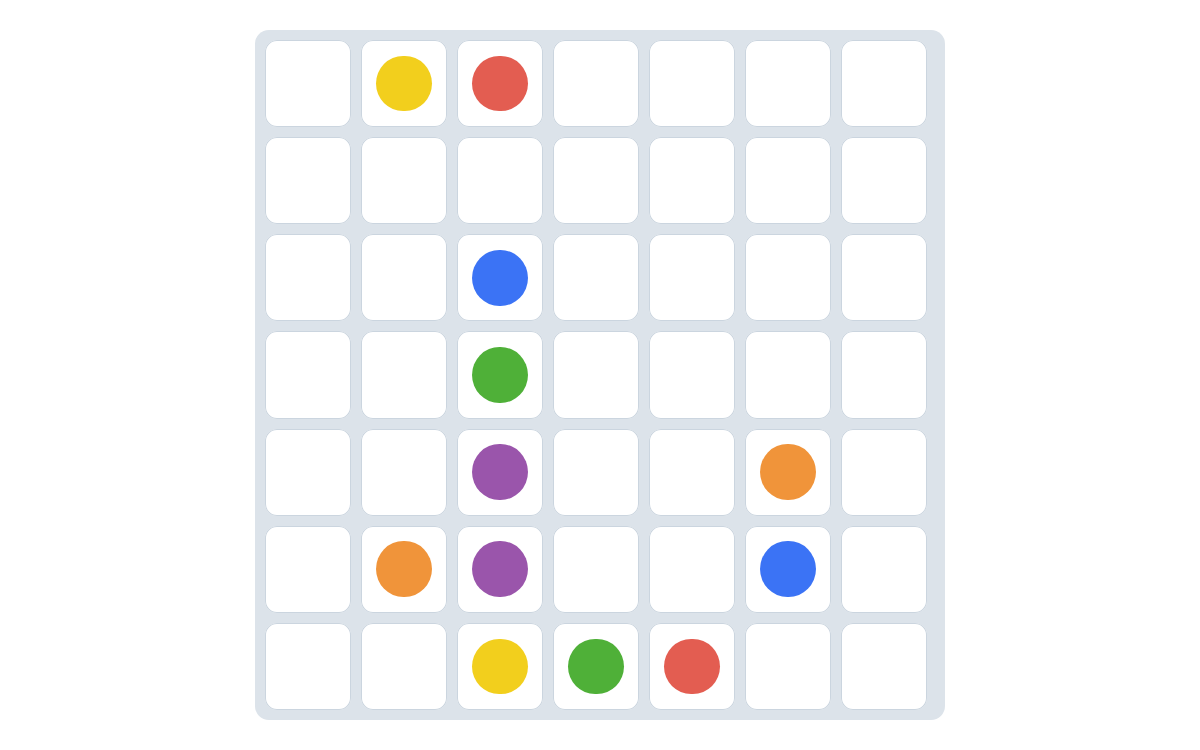
An example question, as candidates see it.
Practice Colour Path Test
Candidates get untimed practice questions with feedback before the test starts. See the full test details on iTestHub.
Colour Path Test Report
Results are reported in the same way as our other tests: an Assessor Report showing the candidate's score band (Very Low to Very High) with interview questions, and a Candidate Report with no scores, giving supportive development advice.
See Colour Path Test on iTestHub
How to Do Well in Your Colour Path Test
- Start with the edges: Pairs near the edges and corners usually have fewer possible routes.
- Look for forced moves: If a cell can only be reached one way, draw that path first.
- Fill every cell: A solution leaves no empty squares, so a gap means a path needs to move.
- Undo freely: Changing a path costs nothing, so try a different route if you get stuck.
More Free Tests
Try additional psychometric tests for free:
Take a Free SJT Take a Free Personality Test Take a Free Critical Reasoning Test Take a Free Barista SJT